Cold Brew Tea is made by steeping loose leaf tea in cold or room-temperature water for several hours.
The slow extraction produces a drink that is noticably smoother, naturally sweeter and significantly less bitter than the same tea brewed hot, without any special requirement beyond a jar and your fridge.
Cold brew tea is any tea or infusion steeped in cold water, typically between 4°C and 20°C (39°F and 68°F) for an extended period, usually for up to twelve hours.
Unlike Iced Tea, which is brewed hot and then poured over ice, cold brew tea extracts its flavour slowly at low temperature from the start.
The result is chemically different from hot brew. Cold water dissolves different compounds from tea leaves than hot water does; fewer tannins (which cause bitterness and astringency), less caffeine and a highter proportion of the amino acids.
The difference comes down to extraction chemistry. When you brew tea in hot water, the heat rapidly dissolves a broad range of compounds including catechins and tannins, which are responsible for the bitter, dry sensation at the back of your mouth. Hot water also extracts caffeine quickly and in higher concentrations.
Cold water is far more selective. It extracts the sweeter, more soluble compound amino acids like L-theanine, natural sugars, and delicate aromatic molecules while leaving much of the bitterness behind. This is why a Gyokuro brewed cold tastes almost sweet and creamy, while the same tea brewed at 60°C (140°F) can taste sharp and grassy.
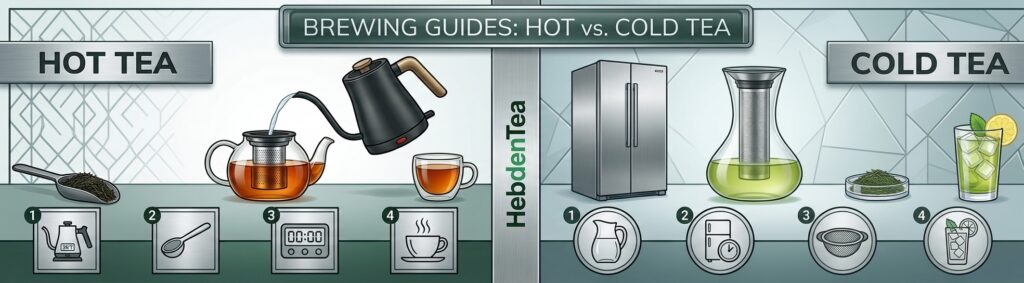
| Feature | Hot Brew | Cold Brew |
|---|---|---|
| Extraction time | 1-5 minutes | 4-12 hours |
| Tannin extraction | High | Low |
| Caffeine level | Higher | ~30-40% lower |
| Bitterness | Can be significant | Minimal |
| Natural sweetness | Moderate | Higher |
| Liquor clarity | Slightly cloudy | Very clear |
| Fridge shelf life | 1-2 days | 2-3 days |
You don’t need any specialist equipment.
A clean glass jar or jug with a lid is all that’s required.
Equipment:
Please note: This section only shows the tea leaves.
For fruit and herbal infusion iced options see:
Our recommendations:
Oolongs are stunning cold brewed.
Cold extraction highlights their floral, orchid-like aromatics and creamy body.
White teas cold brew into a pale, clean liquor with delicate floral and hay-like sweetness.
We recommend our white tea ‘Shangri-La’ from Nepal as it has gentle, natural fruity notes.
Here you can decide between the options of first-flush and second-flush Darjeelings.
Our First-Flush Darjeeling is recommended for soft grassy notes. This will provide you with a soft golden-green infusion.
Our Second-Flush Darjeeling, you can choose for slightly mature refreshing tastes and a soft amber cup.
Either way, the cold extraction removes almost all astringency, leaving only the complex floral and muscatel notes.
Full-bodied black teas can cold brew but require care. Use less leaf (4g per 500ml) and don’t steep longer than 8 hours.
Yes, significantly. Cold water extracts roughly 30-40% less caffeine than hot water.
Iced tea is brewed hot and cooled. Cold brew tea is never heated; it extracts at a low temperature from the start.
Once strained, it keeps for 2-3 days in a sealed glass container.
You can, though the result reflects the quality of what’s inside. Loose leaf produces a substantially better result.
Cold brew made from true tea contains caffeine.
For children, cold-brewed herbal infusions such as rooibos or fruit blends are the best option as they are naturally caffeine-free.